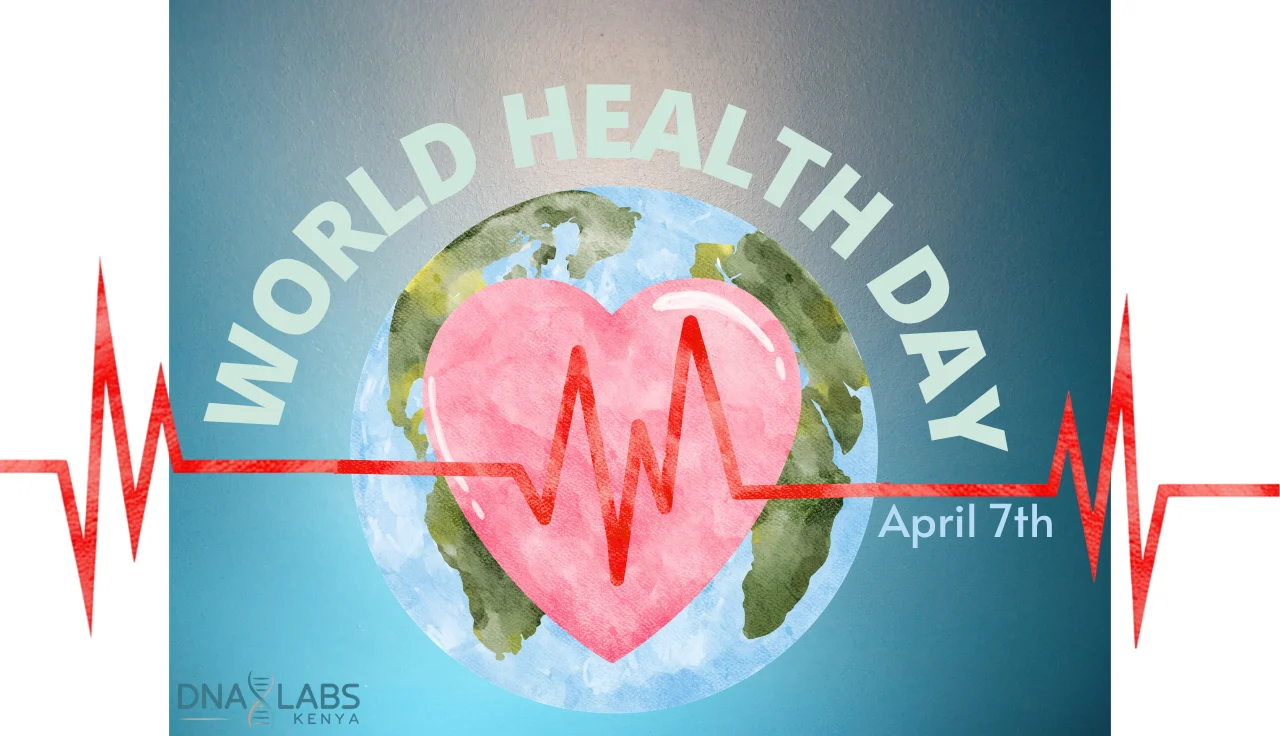
World Health Day 2026, themed “Together for health. Stand with science,” marks a pivotal shift in Kenya toward evidence-based wellness. As the Social Health Authority (SHA) scales, DNA Labs Kenya provides the molecular precision necessary to move beyond general awareness into diagnostic literacy, ensuring every Kenyan family’s health decisions are backed by rigorous scientific data.
What is the theme for World Health Day 2026?
The 2026 theme, “Together for health. Stand with science,” emphasizes global collaboration and the rejection of health misinformation. It calls for a unified front where scientific achievements in Molecular Diagnostics and international cooperation protect the health of people, animals, and the planet, turning evidence into actionable medical outcomes.
In 2026, the World Health Organization (WHO) and the international community have moved past the reactionary measures of previous years. The focus is now on “Standing with Science” as a defensive wall against the “infodemic” of unverified health claims. At DNA Labs Kenya, we interpret this theme as a mandate for Scientific Collaboration. By integrating local diagnostic trends with global standards, we ensure that a blood test in Nairobi or a DNA swab in Mombasa meets the same exacting criteria as those in the world’s leading research hubs.
How does the “One Health” approach impact Kenyan families?
The “One Health” approach recognizes that the wellbeing of Kenyan families is inextricably linked to animal and environmental health. By monitoring zoonotic risks and environmental pollutants, this framework prevents disease outbreaks at their source, ensuring a safer food supply and healthier living conditions for both urban and rural households.
Following the 2026 International One Health Summit guidelines, Kenya has intensified its focus on the human-animal-ecosystem interface. For the average family, this means:
- Reduced Zoonotic Risk: 75% of emerging infectious diseases are zoonotic. Enhanced surveillance prevents these from reaching your doorstep.
- Food Security: Scientific monitoring of livestock health ensures that the meat and dairy on Kenyan tables are free from harmful pathogens.
- Environmental Safety: Identifying toxins in our soil and water helps mitigate long-term chronic illnesses.
At our Nairobi laboratory, we see the shift toward this holistic view every day. We no longer just treat a symptom; we look at the biological evidence that connects a patient’s health to their broader environment.
Why is evidence-based testing critical for Kenya’s Social Health Authority (SHA) goals?
Evidence-based medicine is the engine of the Social Health Authority (SHA). To achieve Universal Health Coverage, the SHA relies on precise diagnostics to eliminate wasteful spending on “trial-and-error” treatments. Accurate testing ensures that SHA funds are directed toward therapies that are scientifically proven to work for each specific patient.
The transition from the NHIF to the Social Health Authority (SHA) represents Kenya’s most ambitious health reform to date. However, the sustainability of the Social Health Insurance Fund (SHIF) depends entirely on clinical efficiency.
- Precision over Presumption: Molecular diagnostics allow for targeted treatments, reducing the duration of hospital stays.
- Fraud Prevention: Digital health systems backed by verified lab results prevent the “ghost claims” that previously drained national resources.
- Standardized Care: Whether you are in a level 4 county hospital or a national referral center, scientific evidence remains the “gold standard” for care.
Information Gain: Why “Diagnostic Literacy” is the New Empowerment
In 2026, awareness is no longer enough. We are entering the era of diagnostic literacy. While “Health Awareness” tells you that diabetes is a risk, “Diagnostic Literacy” empowers you to understand the specific molecular markers in your lab report.
At DNA Labs Kenya, we believe that a patient who can read their own results is a patient who can truly advocate for their health within the SHA system. We are moving away from a world where science is a “black box” and toward one where every Kenyan has the tools to interpret the data that defines their life.
The 2026 “Health-First Urbanism” Trend
Kenya’s major cities are undergoing a radical transformation known as Health-First Urbanism. This trend integrates:
- Wellness Zones: Redesigning Nairobi’s “School Streets” to encourage walking and reduce air pollution.
- Green Infrastructure: Expanding public parks in Mombasa to lower urban heat and improve mental health.
- Integrated Services: Locating diagnostic hubs within residential “walkable” zones to make science a part of daily life.
Key Scientific Achievements of 2026
- Real-Time Zoonotic Tracking: Implementation of satellite-linked biosensors in Kenya’s agricultural zones to detect Rift Valley Fever early.
- SHA Digital Integration: The full migration of 29 million Kenyans into a blockchain-secured health data registry.
- Advanced Paternity Precision: The shift to 50-marker DNA testing as the standard for Kenyan immigration and legal cases.
- Molecular Surveillance: Using genomic sequencing to track and neutralize antibiotic-resistant bacteria in urban hospitals.
Common Health Myths vs. Scientific Evidence
| Myth | Scientific Evidence (2026) |
| “DNA testing is only for paternity disputes.” | Molecular Diagnostics are now essential for personalized cancer therapy and predicting hereditary risks. |
| “Natural immunity is always better than science-based intervention.” | Science-backed vaccines and treatments provide a controlled, safe immune response without the high risk of organ damage from raw pathogens. |
| “One Health is only for farmers.” | Urban outbreaks (like respiratory viruses) are directly linked to how we manage city waste and animal proximity. |
| “Lab results are too complex for non-doctors.” | Diagnostic Literacy tools now help patients understand their biomarkers through simplified, AI-assisted reporting. |
Final Thought: As we celebrate World Health Day 2026, remember that your health is not a matter of chance—it is a matter of science. By choosing evidence-based testing and demanding diagnostic clarity, you are not just protecting yourself; you are helping build a resilient, scientifically-grounded Kenya.